







v1.0 · Agent skill · Local · MIT
Point, pick, approve. Your agent does the rest.
bluedoc turns plans, code reviews, architecture docs, UI designs, slide decks and store listings into interactive pages. Comment on any element, pick an option, approve. Your agent reads the answers and gets on with it.
claude plugin marketplace add andreiverdes/bluedocclaude plugin install bluedoc@bluedoccodex plugin marketplace add andreiverdes/bluedoccodex plugin add bluedoc@bluedocpi install git:github.com/andreiverdes/bluedocomp plugin marketplace add andreiverdes/bluedocomp plugin install bluedoc@bluedoccopilot plugin install andreiverdes/bluedocgit clone https://github.com/andreiverdes/bluedoc.gitagy plugin install bluedoc/antigravitynpx skills add andreiverdes/bluedocOne home for every doc
Every doc your agent writes, in one place.
The local server lists each doc with its type, status and revision. Filter by type or status, browse projects in the sidebar, and open a doc to read, comment and decide.

How it works
One loop, from draft to approved.
The agent writes, you answer on the page, the agent revises. Each round is a revision you can compare with the last.
Agent writes
One JSON file. The local server renders it as a page; no HTML to keep in sync.
You mark up
Pin a comment on any element, a selected passage or a box you draw.
You decide
Pick an option per question. The agent’s recommendation is starred.
Agent revises
It edits one part at a time and marks the comments it resolved.
You approve
Approve the current revision; the agent waits for it before it writes code.
Doc types
Eight kinds of page, one way to answer them.
Each type has its own layout and its own decisions. Comments, revisions and approval work the same on all of them.
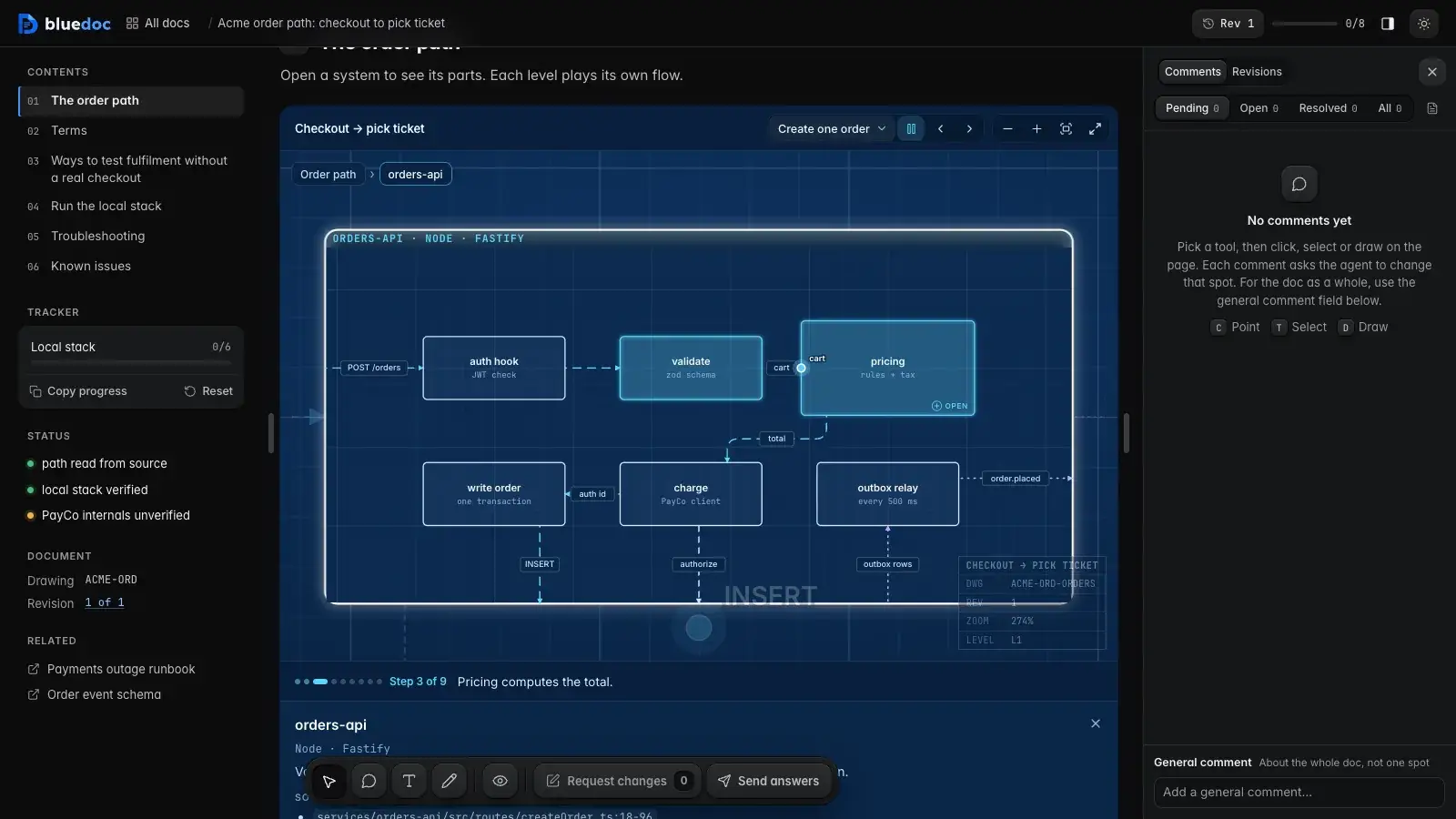
Docs
docsArchitecture pages, walkthroughs, runbooks, setup guides and change proposals.
- A zoomable blueprint canvas, nested up to 3 levels
- Animated flows: a request, an event, a data path
- Checklists whose ticks the local server keeps
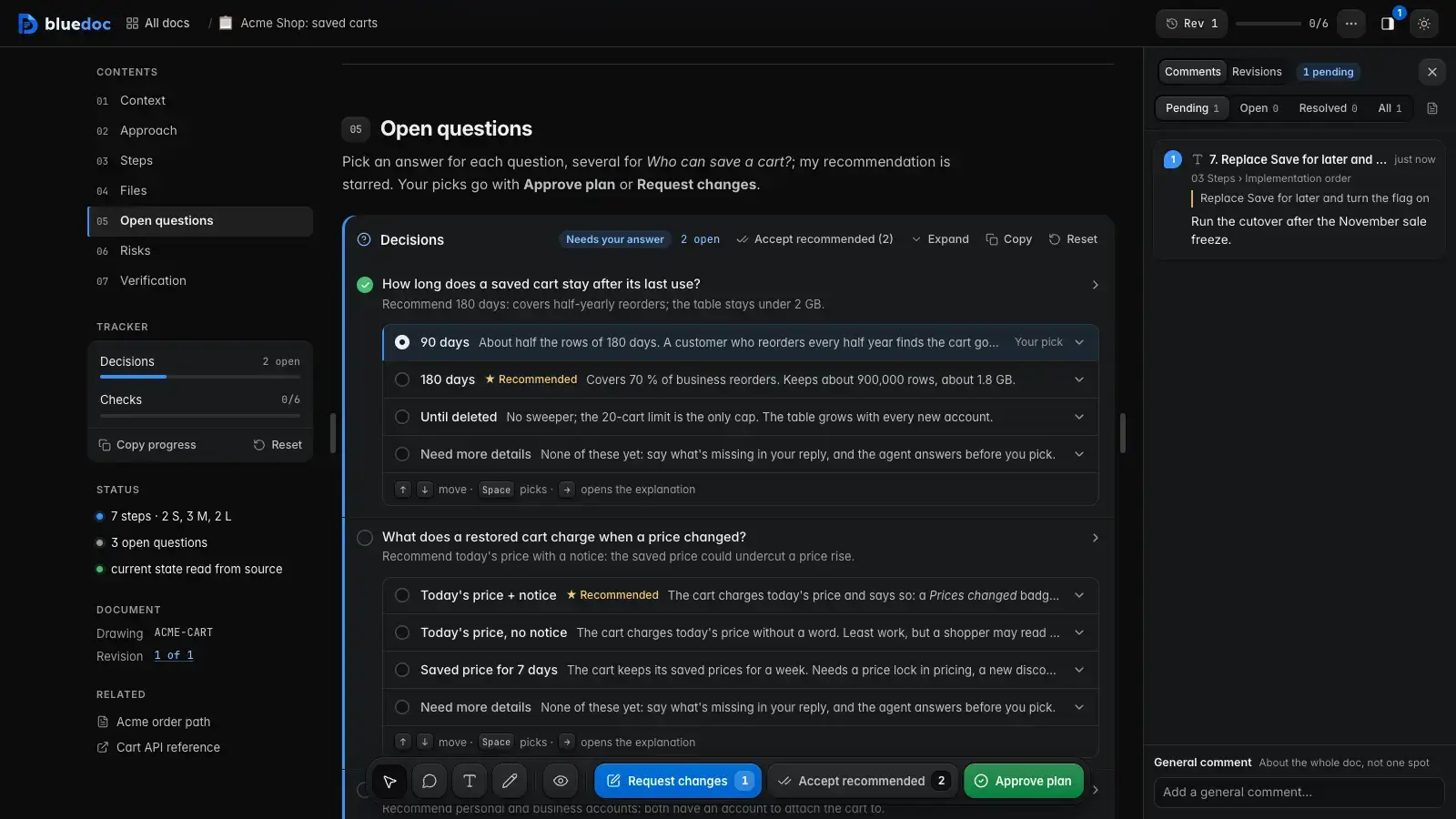
Plans
planA plan you approve or send back before the agent writes code.
- Steps, files, risks and checks on one page
- Open questions with the recommendation starred
- The agent waits for Approve plan
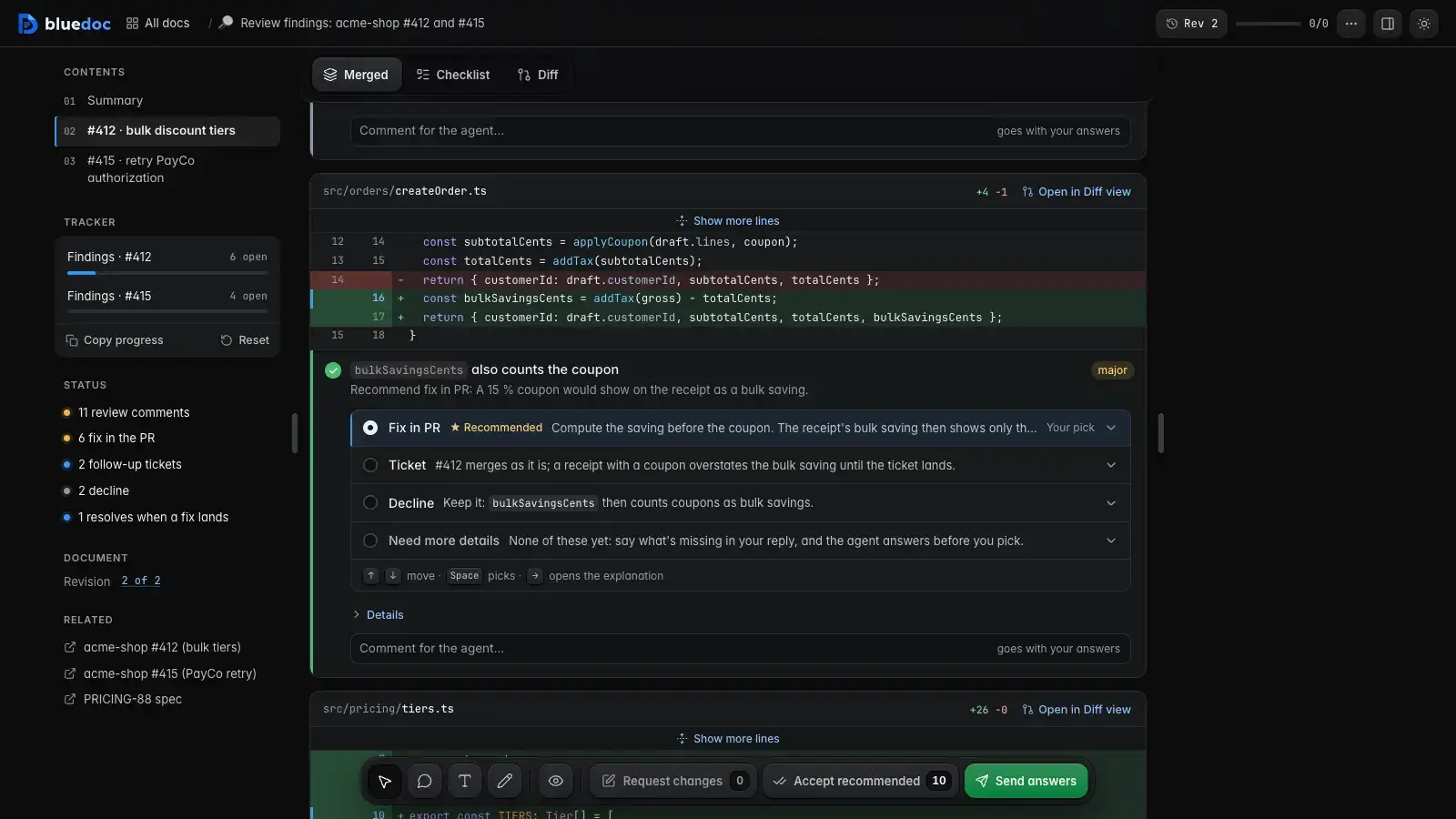
Reviews
reviewReview findings pinned to their lines from git, one decision per finding.
- Diffs expanded from git on each render
- Fix in PR, Ticket or Decline, with a reason
- GitHub review threads imported as findings
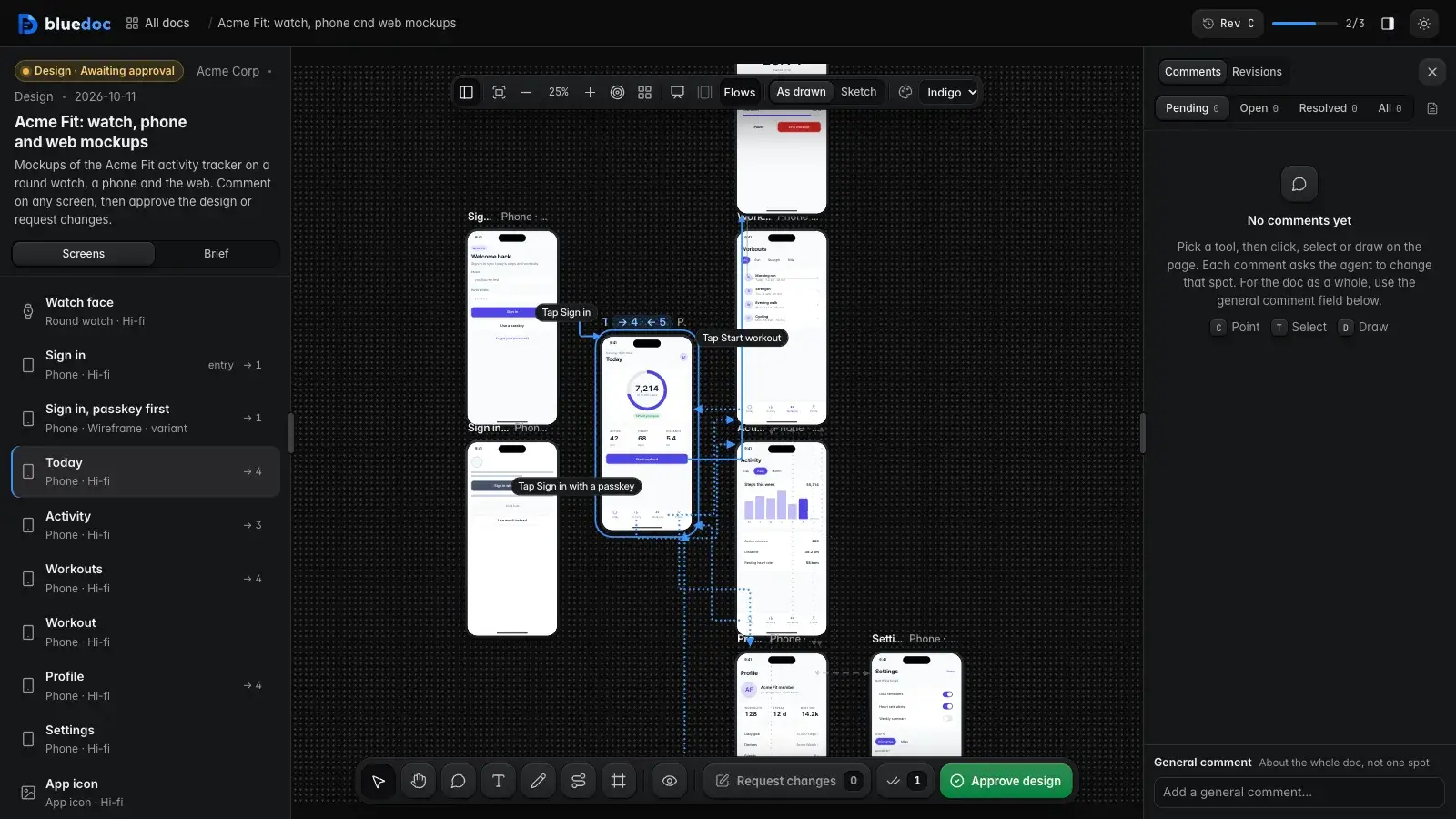
Designs
designUI screens on a pan-and-zoom board, and app icons.
- Watch, phone, tablet, desktop and browser frames
- Screens link to each other; Present follows the taps
- App icon sheets with PNG export
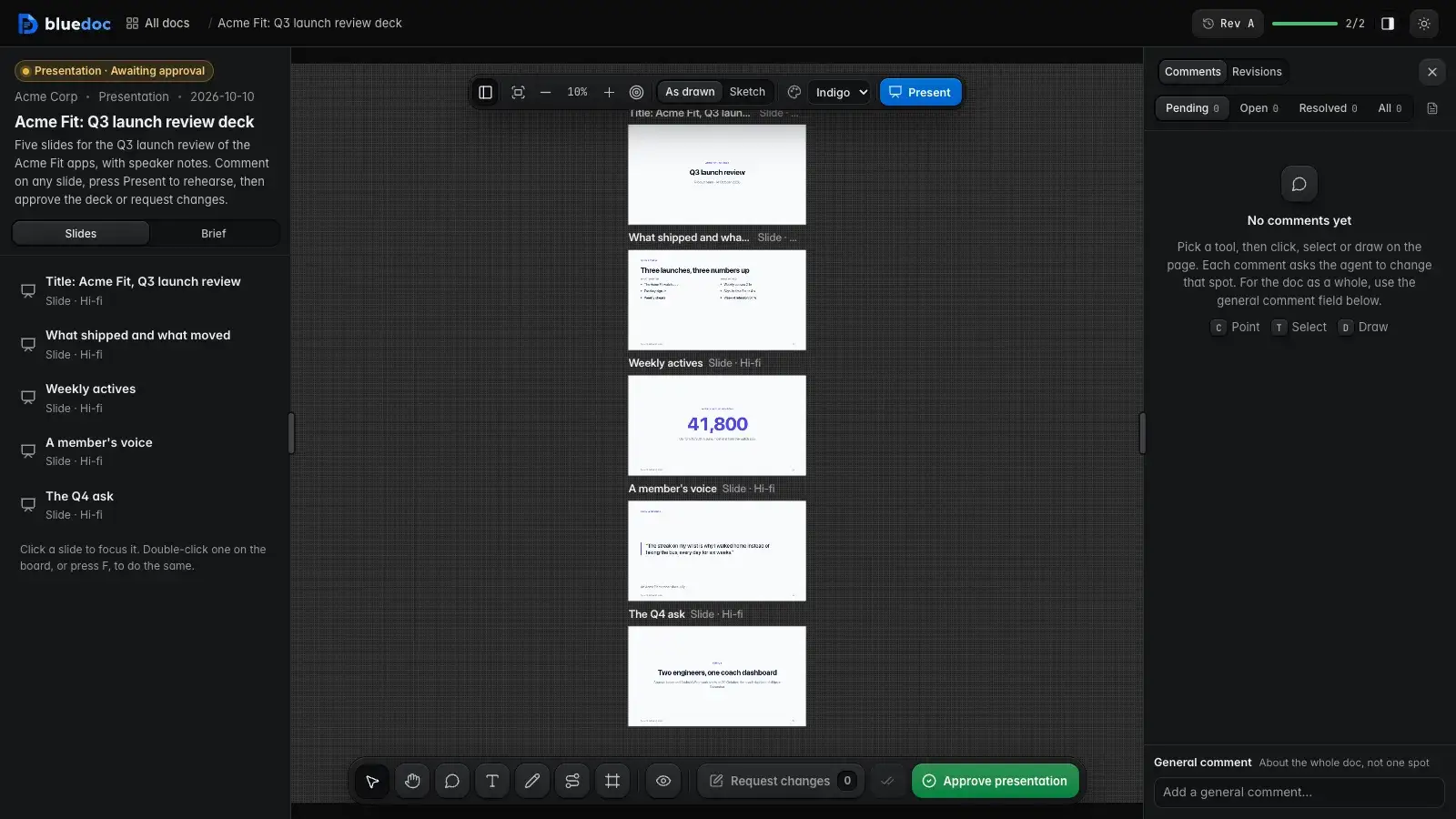
Presentations
presentationSlide decks with speaker notes, played in Present.
- 16:9 HTML slides in deck order
- ← → to step, N for notes, Esc to leave
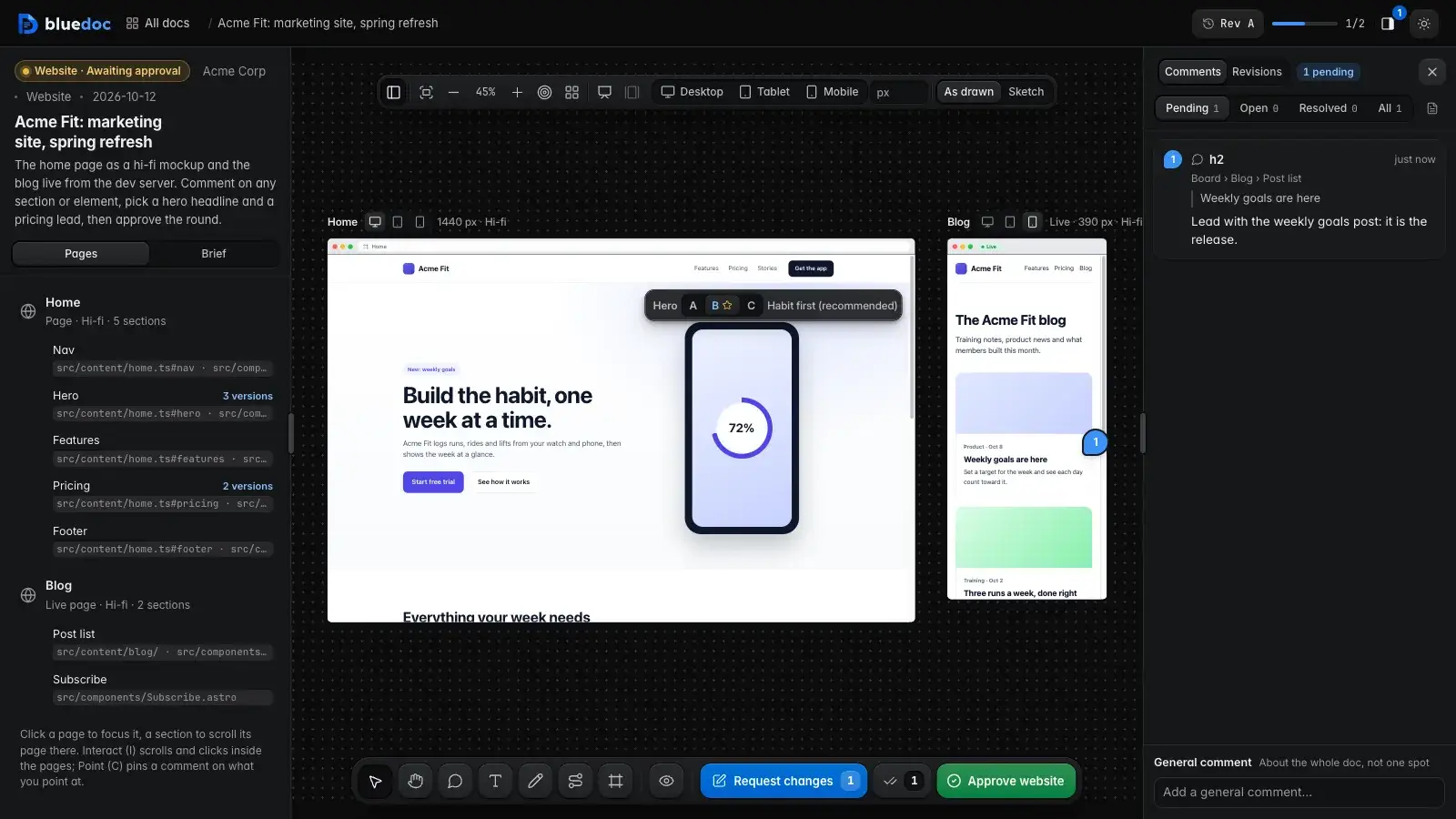
Websites
websiteA site’s pages on a board, live from its dev server.
- Live pages from localhost, hot reload included
- Comments that name the source file to edit
- Versions of a section, picked in place
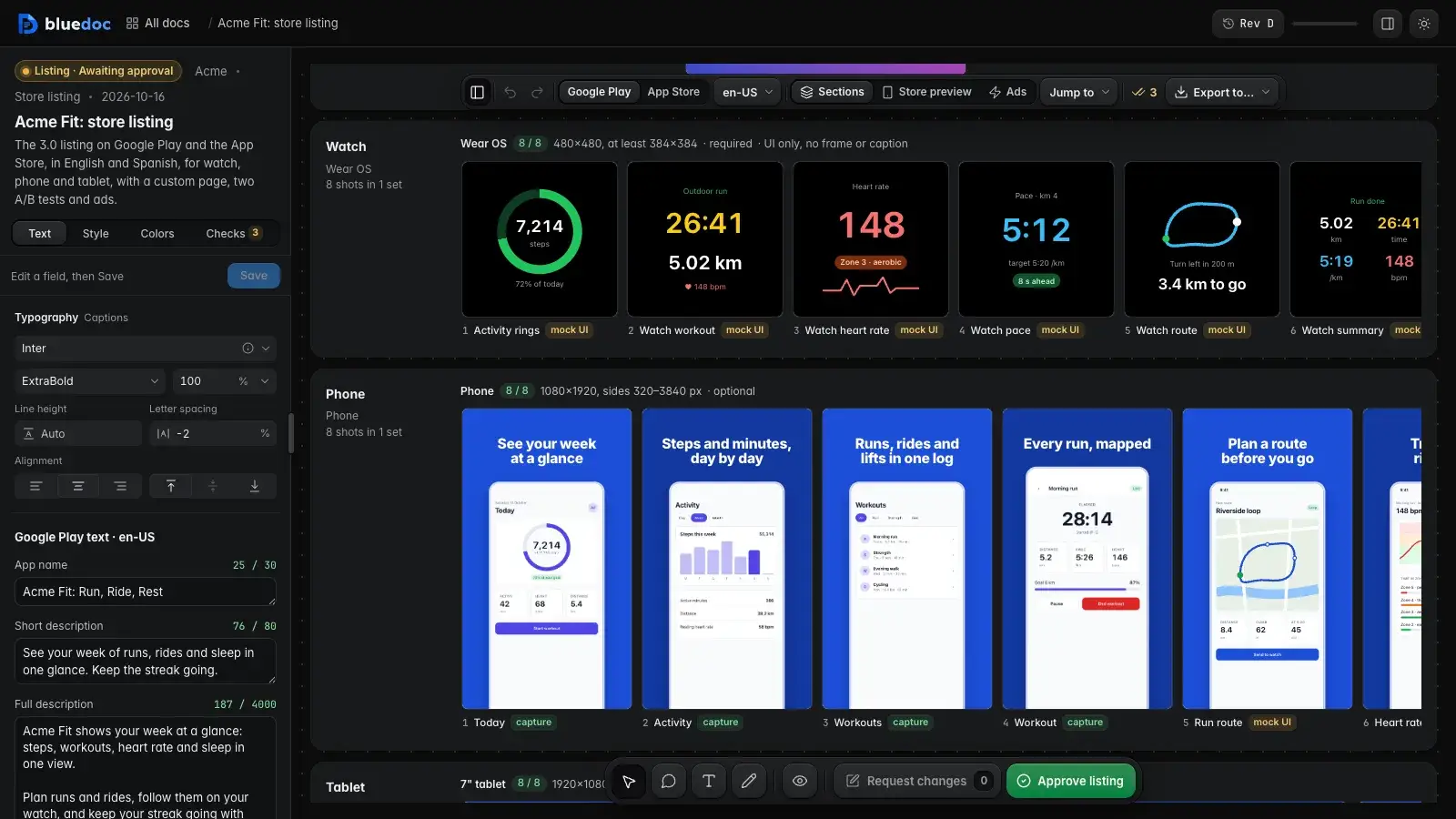
Store listings
storelistingAn app’s Google Play and App Store listing, checked against the stores’ rules.
- Screenshots per device at each store’s sizes
- Store text per locale, with live counters
- Store checks, variants, ads and a fastlane ZIP
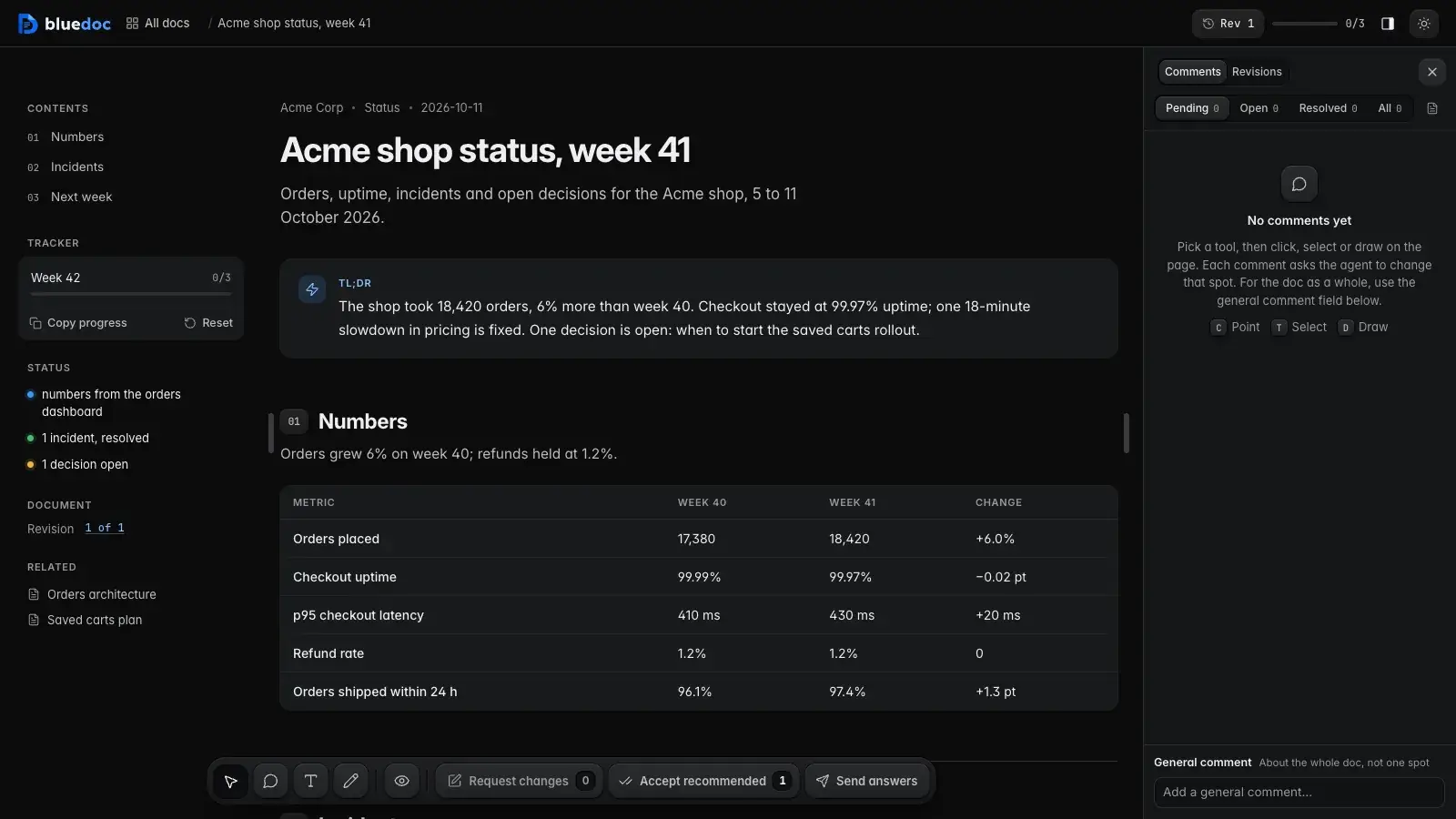
Other
otherStatus pages, incident reports, inventories, meeting notes and comparisons.
- A TL;DR, then one section per question
- A hero stat that sums the page up


Features
Built for answering, not just reading.
A wall of text in a chat asks you to reply in prose. A bluedoc page asks you the questions and keeps your answers.
Comments that become conversations
Point at an element, select a passage or draw a box. Each note, item and general comment is a thread the agent replies in.
Options as rows, recommendation starred
Each option explains itself in a line. Pick one, or several where a question allows, or Accept recommended to take every starred option.
Revisions you can compare
Every build is a revision. Compare any two: new, changed and removed parts are marked in place, word by word.
Approve, and the agent proceeds
Plans, designs, decks and store listings wait for approval on the current revision. Request changes sends them back.
Your input stays on your machine
Ticks, picks and comments live in a local SQLite file the server owns, never in the repo. Screens run sandboxed, with no network.
Works with your agent, plan mode too
Claude Code, Codex, Copilot CLI, Antigravity CLI, pi and omp install it as a plugin, with /bluedoc-* commands. In plan mode, the plan opens as a page and waits for your approval.
JSON in, page out
The agent writes JSON. You get a page.
Agents never write page HTML. The server renders each doc from its JSON on every request, so an edit and a reload is the whole build.
{ "title": "Acme Shop: saved carts", "meta": { "type": "plan", "rev": "1" }, "sections": [{ "title": "Open questions", "blocks": [{ "type": "checklist", "id": "decisions", "items": [{ "id": "retention", "recommend": "d180", "text": "How long does a saved cart stay?", "choices": [ { "id": "d90", "label": "90 days", "md": "Half the storage." }, { "id": "d180", "label": "180 days", "md": "Most reorders fit." }, { "id": "forever", "label": "Until deleted", "md": "No sweeper." } ] }] }] }]}
Install
Pick your agent.
Each one installs the same skill from the GitHub repository.
claude plugin marketplace add andreiverdes/bluedocclaude plugin install bluedoc@bluedocInside a session the same commands are /plugin marketplace add andreiverdes/bluedoc and /plugin install bluedoc@bluedoc. Start a new session to load the skill.
codex plugin marketplace add andreiverdes/bluedoccodex plugin add bluedoc@bluedocRestart Codex. Mention the skill with $bluedoc or let Codex pick it from your request. Plan mode (/plan) opens the plan as a page; the README has the sandbox lines that skip the approval prompts.
pi install git:github.com/andreiverdes/bluedocRestart pi. /bluedoc-plan-mode turns on plan mode, and the plan opens as a page for your approval.
omp plugin marketplace add andreiverdes/bluedocomp plugin install bluedoc@bluedocRun /reload-plugins in an open session, or start a new one. omp’s plan reviews open as pages: Approve runs the plan, Request changes refines it.
copilot plugin install andreiverdes/bluedocStart a new session. When Copilot leaves plan mode, its plan opens as a page and waits for your approval.
git clone https://github.com/andreiverdes/bluedoc.gitagy plugin install bluedoc/antigravityRestart agy. In plan mode (agy --mode plan or /plan), the implementation plan opens as a page for your approval.
npx skills add andreiverdes/bluedocFor any other agent that reads skills. Or clone the repository and link skills/bluedoc into your agent’s skills folder.
Needs: Python 3.9 or later on PATH · git, for code reviews · gh, only to import GitHub review threads.
FAQ
Questions, answered.
Is it free?
Yes. bluedoc is open source under the MIT licence. There is no account, no subscription and no hosted service.
Which agents does it work with?
Claude Code, Codex, Copilot CLI, Antigravity CLI, pi and omp install it as a plugin, with a plan-mode gate and /bluedoc-* commands. Any other agent that reads skills can get it with the skills CLI (npx skills add andreiverdes/bluedoc) or a copy of the skill folder.
Where does my data live?
On your machine. Ticks, picks, comments and replies live in ~/.bluedoc/state.db, a SQLite file the local server owns, never in the repo. Only a browser that opened a link from the server can save.
Does it need an internet connection?
No. The server runs on 127.0.0.1 and serves its fonts, styles and UI kits itself. Design screens run sandboxed with no network. Only importing GitHub review threads, or diffing a PR whose repo isn’t checked out, calls gh.
Can I export a doc?
Yes. Add -o name.html to the build command for a standalone HTML file you can send to someone. Decks also export as PDF, and store listings as a fastlane ZIP, a plain-folders ZIP, a PDF or HTML.
What licence is it under?
bluedoc’s own code is MIT. The vendored HorizonUI build is Apache-2.0, and the fonts it ships are SIL OFL 1.1. The repository’s README lists every third-party licence.
Approved · rev 1
Answer your agent on a page.
Install the skill, ask your agent for a plan, and answer it on a page.